The majority of the students have to pay fees (fees, in fact, an extortionate amount) at the time of joining technical institutions in India (engineering colleges, management institutes, diploma schools, etc). What if a student withdraws from admission, or doesn’t join despite paying? This is where the AICTE refund policy plays a role.
AICTE refund policy is the list of guidelines according to which an institution that is approved under the all India Council for Technical Education (AICTE) will have to return fees paid by a student who withdraws his or her admission. This policy is key to preventing students from being exploited by colleges, particularly private colleges, and making the process of collection and refund of fees transparent.
In this article, we delve deep into the AICTE refund policy and look at what it involves, how it operates, when refunds are due to be made, the responsibilities of institutes in processing refunds, penalties for non-compliance by institutions, and what students can do if they face delays or denial of refund.
Read Also: American Eagle Return Policy: No Time Limits, Easy Refunds, and Full Customer Guide
Laws Behind The AICTE Refund Policy
It is not just a guideline; AICTE’s refund policy has been incorporated in its regulatory framework.” The key one is the AICTE (Grant of Approvals for the Technical Institutions) Regulations 2016 that prescribe what institutions need to do when students opt out.)
According to Regulation 10 of the 2016 Regulations, there is a clear guideline from AICTE regarding how refund cases are to be dealt with:
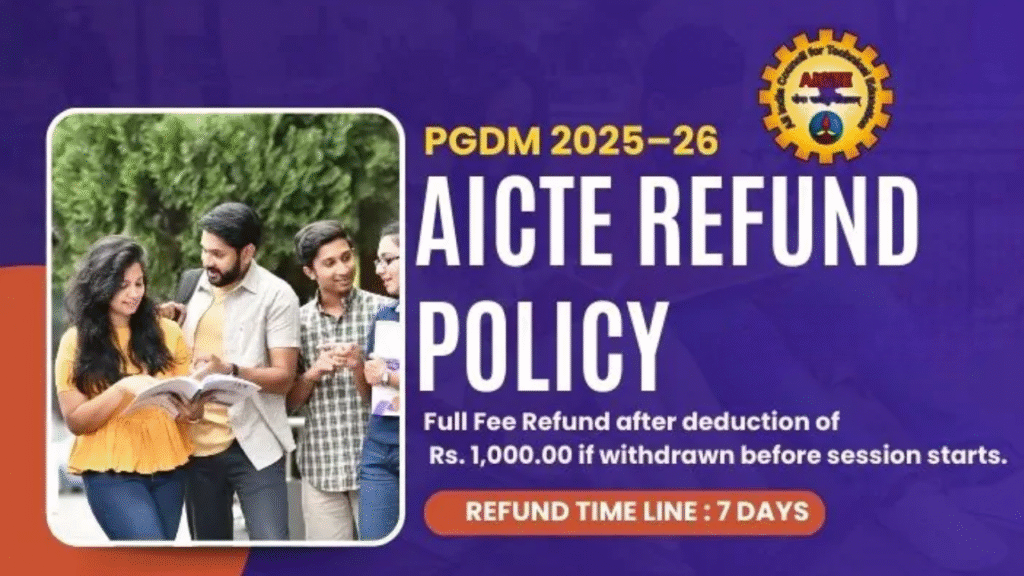
- In case the student withdraws from joining the course before commencement of such, the fee may be refunded after deducting not more than Rs. 1,000/- as processing charges.
- If a student leaves after joining and if the seat is filled by another student before the last date of admission, “the institute should refund the fee collected after making pro rata deductions every month,” such as tuition and hostel charges.
- When the seat is not filled allotted security deposit and original document will be returned on producing the Original Admission Order with endorsement “Seat Not Allotted Once Filled”. latestlaws. com
- In addition, the institution is prohibited from collecting fees for subsequent years if a student cancels admission at any point. Indian Kanoon
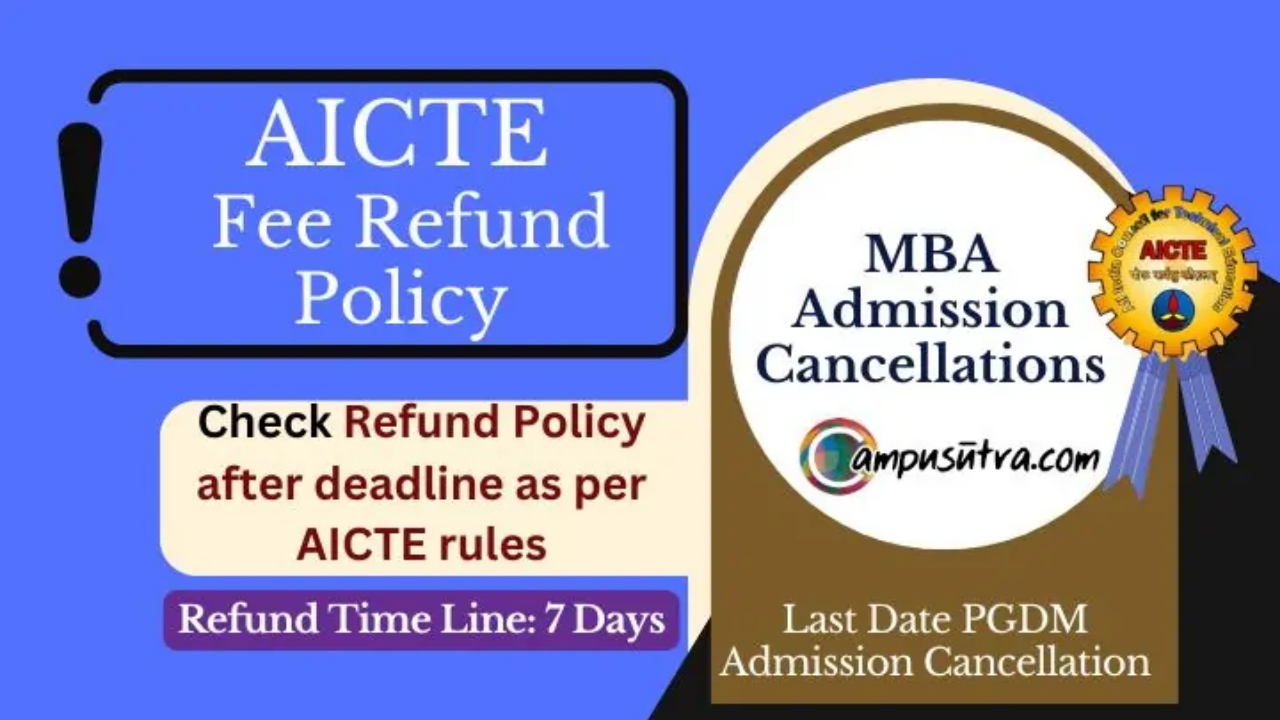
- As per AICTE, the refund (including return of original certificates) shall be made within 7 days of cancellation.
- These are not goals issued to inspire the institutions; they are the numbers required by AICTE’s regulation.
Amendments & Tougher Penalties
The organisation has accordingly modified these regulations to make the refund policy stringent and also penalize colleges that do not abide by it.
The 1st Amendment Regulations, 2017, revised Clause 10.10 (refund cases). The amendment upped the punitive ante for noncompliance.
According to the amended policy, if the institution fails in providing such a refund or violates AICTE refund policy norms, then it can create an impact on the institution financially with a penalty of five times of total fee received from a student being imposed by AICTE.
NRI/supernumerary approval being disapproved, reduction in intake for which sanction was granted, admission not allowed in one or more years of courses, Non-approval to AICTE for any other course at the institution.
These severe fines are designed to compel schools not to mishandle student money and meet their refund duties.
Read Also: IRCTC Refund Policy: Comprehensive Guide for 2025
Detailed Provisions of AICTE Refund Policy
a) Withdrawal Before Course Begins
The full fee collected from a student should be refunded unless, in the case of students withdrawing within one week of the starting date of the course, that charged under Sub-clause less: (i) ₹1,000; if the seat consequently falling vacant is filled by another candidate before…
Original school/college leaving certificates cannot be kept by the institute. Indian Kanoon
Full refund (excluding processing fee) must be completed within 7 days. latestlaws.
b) Leaving After Admission for Last Admission Date
If a student leaves after taking admission but a seat gets filled by another student before the last date of cutoff or admission, the institute will return fees after “making deduction of proportionate deductions. These deductions are in the form of monthly fees paid out by parents on monthly tuition and hostel rent (for boarders).
Refund, along with the certificates, should be effected once again within 7 days.
c) Withdrawal After Joining but Seat Remains Vacant
- If empty positions are not filled, then the following agency is to:
- Refund the security deposit fully.
- Return the original academic documents.
- Not charge tuition in the future for the present year’s withdrawing student.
Deadlines & Timelines For AICTE Refund Policy
AICTE has this policy that you can withdraw and still avail a refund, but it’s difficult to know at what stage you have to stop.
The Institution follows the Guidelines stipulated under AICTE (the 2018 version of AICTE regulations) for course withdrawal. In such cases, the last date for withdrawing from a program is both admitted and the fee refunded by UOU on 30th June of the Academic year.
According to AICTE, the Refund + Return of the document should be made within 7 days after the withdrawal request is submitted.
And the academic calendar (or admission withdrawal schedules) published by these institutions is aligned with AICTE’s deadlines, so do ensure you check your institute’s policy and what AICTE lays down. Example: Academic calendar of an AICTE-approved college clearly mentions the 7-day refund window.
Read Also: Adidas Refund Policy: Full 2025 guide to returns, refunds and exchanges around the world
College’s Duty as per the AICTE Refund Policy
Makes it mandatory for the AICTE-approved institutes to comply with the refund policy of AICTE as under:
Transparent Fee Structure
Fees Details All heads of fees (Tuition Fee, Exam Fee, Hostel Rent Deposit, etc.) must be prominently displayed, including institution hostel rents and exam fees.
They can’t charge you any hidden or additional fees beyond what is agreed to and disclosed.
Communication of Refund Policy
At the time of admission, the refund policy (processing fee, deadlines and process) should be informed to the students.
They should have a set formal format of “withdrawal of admission + refund” to the student.
Processing Refunds Promptly
Upon receipt of a genuine withdrawal application, the institution has to make a refund within 7 days and send back the fee (30% processing charges would be deducted) along with the original leaving/school certificates.
In the event the seat is occupied (post joining), then pro-rata deductions have to be calculated properly and a refund made.
No Future Fee Demand
In case the students cancel admission, it is illegal for institutes to demand future years’ fees.
Compliance Enforcement
In case of default, the institutions are heavily fined (up to 5 times the fee), reduction in seats or suspension, and can even be de-affiliated by AICTE.
Such a penalty amount may also be imposed by AICTE through its portal (payment gateway) in default of the same.
Violations-Regulatory Enforcement
AICTE refund policy has already shown that it will not take the issue of refund against its refund rules lightly. Key things to do when a default occurs:
- Penalties: Institutions are subject to fines of up to 5 times the fee charged for a student if they fail or delay processing refunds.
- Sanctioned intake: The Number of admitted students can be decreased.
- Withdrawal of Approvals: Repeat violations of refund norms can lead to the withdrawal of approval for the course or the entire institute by AICTE.
- Return of the Documents: Along with cash, original certificates are returned by the institutes, and AICTE makes sure that keeping back the students’ documents is not used as a pressure tactic.
The fact that such stringent compliance actions exist is indicative of the importance which AICTES assigns to following its refund policy.
Read Also: Expedia Refund Policy: How to Cancel Flights, Hotels & Packages for a Full Refund
Why Does the AICTE Refund Policy Matter?
Knowing how to follow and implement the AICTE refund policy for students is important for:
- Security: The students pay huge amounts in the form of fees, deposits, and security. Refund policies, by contrast, protect registrants from being penalized unfairly if they change their mind early on or have good cause for dropping out.
- Transparency & Accountability: By fixing the amount that can be deducted(processing fee) and by giving conditions for refund, AICTE promotes greater accountability amongst institutions.
- Guarding Against Misuse: Some institutions are going to want to retain student funds and/or delay providing refunds, and add all sorts of arbitrary deductions. AICTE’s policy prevents such misuse.
- Benefits to Students: The policy is student empowering. Institutions that don’t comply can be reported by students, and AICTE has the power to penalize or even derecognize them.
- Regulatory Integrity: To maintain the credibility of technical education in India, regulatory authorities like AICTE need to strictly enforce such regulations, it helps restore faith in the system.
Common Challenges & Gaps In AICTE refund policy
While AICTE has an elaborate refund policy, there are day-to-day problems and ground-level considerations that students come up against:
- Delay in refunds by Institutes: Some of the technical institutions are taking more than 7 days to process the refund , beyond 7 days as stipulated by AICTE. The Times of India
- Non-refund after Not Filling the Seat: In case a seat falls vacant and goes unfilled, institutions may still not refund the security deposit or the original document.
- Ignorance: There is a lack of knowledge among students regarding what the AICTE policy exactly is. They may be unaware that only up to ₹1,000 can be deducted as a processing fee legally.
- Red Tape: Some colleges require written applications or force students to go into special formats, which can be onerous.
- Retention of Certificates: Some colleges retain Original mark sheets/certificates, to deter the student from leaving or getting transferred – AICTE has made this illegal. Indian Kanoon
- Weak Enforcement: Despite the power of AICTE to impose penalties, “not all students will be in a position to complain,” and not every case can come under AICTE’s direct attention.
What can students do if case AICTE Refund Policy is not followed
In case a student feels their institute has violated the AICTE refund policy, there are several courses of action.
Submit Formal Request
Draft a Formal Letter / Application to the Administration of the Institute for Reimbursement as per AICTE standards.
Keep a copy of the application and ensure proof (registered post / email) is available.
Raise a Complaint with AICTE Refund Policy
Well, that’s something we’ll have to check with AICTE or some other agency, and ask what happens if an institution does not pay back students the amount they are due on demand. EnFORCEment and enFORCEment-related violations have been reported in the media.
Offer evidence: fees receipts, refund application, payment proof, institute replies, etc.
Leverage Regulatory Action
AICTE can penalize the college, recovering the stipend amount from them.
“If a student suspects widespread misuse by the institute, students can also approach through RTI and see what action AICTE has taken,” the official said.
Media / Public Pressure
Students can also make a media or a student rights appeal that there is non-compliance.
A glare of publicity can often be helpful, as has been evident in some past coverage of shamed institutions.
Legal Recourse
If authorities remain inactive, the students can look at legal remedies of enforcement (Consumer Court or Civil Court).
Colleges are often faster to act based on legal notices that refer to AICTE Refund Policy rules.
Read Also: Amazon Refund Policy: How Refunds, Returns & Replacements Work
AICTE Refund Policy Analysis: Read other comparisons & guidelines

It is also enlightening to benchmark the AICTE refund policy in the context of other regulatory norms and see how it fits into the larger universe of higher education refund policies.
UGC Refund Policy: The UGC, which governs several more colleges and non-technical universities, too, has a refund policy. As per UGC (University Grants Commission) guidelines, the fees cannot be collected from students if he or she withdraw, and therefore, the AICTE refund policy is consistent with these overarching norms of refund.
HRD Ministry Ban: The HRD ministry (which has transformed to MoE) has already directed AICTE and UGC to ensure that no refund-violating institution is allowed to function in the country. The Economic Times
Approval Process Handbook: The AICTE’s own APH has detailed procedural instructions with respect to refund, withdrawal, and reporting of vacant seats. A number of the refund conditions in the regulations are derived from the APH. (Note: APH review is intended for students to get an idea of institute-specific deadlines).
Recent Trends & Observations For AICTE Refund Policy
In recent years, students have also been voicing their opposition to the delays in getting refunds of fees, particularly from private technical institutes. There have been several complaints and media reports on how, despite AICTE’s stringent rules in place, the implementation is far and wide uneven. The Times of India
AICTE, at the other end, has turned a vigilant body in its rules and amendments; it’s focusing on making refund norms enforceable and penalizing errant institutes.
There is increasingly a push from students and advocacy groups to build better transparency by, for instance, requiring colleges to display refund policy more prominently during the admission process, making it easier to apply for a refund, and ensuring that refunds are paid out promptly.
With the increase in the number of students pursuing higher technical education and cases of fee exploitation on the rise, a good policy is indeed in making as it is in the overall interest of the student.
Read Also: American Airlines Refund Policy 2025 Guide: Everything You Need To Know
AICTE Refund Policy: Practical Tips for Students to Sail
The following are the students who can take some actionable steps to get the best out of the AICTE refund policy :
Read the Admission Brochure Carefully
Check the institute’s admission brochure or website for its refund policy before paying any fee. Ensure that it complies with AICTE Refund Policy regulations (e.g., Processing Fee ≤ ₹ 1,000).
Check whether the institute’s internal dates are tighter; at times, colleges have an internal schedule of their own (they can’t violate AICTE minimum rules).
Get Everything in Writing
Write when you apply for cancellation/refund (email is often most effective) and request confirmation of receipt by the institute.
Retain copies of your fee receipts, application, and letters from the institute.
Follow the Timeline
If you are going to drop out, do so early. You stand a better chance of receiving the full refund (less ₹ 1,000) when you apply early on in advance of your course.
Track important dates: when your institute’s academic session starts, admission deadlines, and the last date of withdrawal with refund as per their internal calendar + AICTE Refund Policy norms.
Verify Refund Mode
Find out what method (cheque, bank transfer, or demand draft) the institute will use to pay you back and when.
Ask back the original documents (leaving certificate, school certificate) while refunding as per the AICTE Refund Policy regulation.
Follow Up Religiously
If the refund is not done after 7 days, call the institution.
If they are not delaying or refusing, escalate to AICTE Refund Policy on their grievance portal or through email. Include all evidence (your application acknowledgement, fee receipt, etc).
Escalate When Needed
- If there is no response, then you file a formal complaint with AICTE.
- Look at the consumer court or legal options if the institute violates the policy and denies a refund.
- Take help of student-advocacy groups, or even media, if required.”
Read Also: G15tool Partners: What They Are, How They Work & Why They Matter
Case Studies & Real-Life Examples: AICTE Refund Policy
These are the real-life scenarios (reported by media and students) that show cases where the AICTE refund policy comes into action:
- ” Times of India in a report: “Even as AICTE deadlines refunds in seven days, students at technical institutes are made to wait for months (or even a year) to get back their fees”. The Times of India
- As per AICTE and UGC norms, the institution has to return not just fees but also original certificates in case students leave the courses midway; action can be initiated against them if they don’t do it, reported NDTV. www. ndtv. com
- On Reddit, students often share notes on their refund experiences:
- “Hey, i got my refund in like a week and they only cut 1000 …” Reddit
- A second student reported that their college refused to refund despite withdrawing admission, claiming the student missed some vague “orientation” deadline, another red flag with AICTE’s specific 7-day cut-off. Reddit
- These ad hoc examples illustrate the power of policy, as well as the difficulty of enforcing it on the ground.
Why Some Colleges Do Not Adhere To AICTE Refund Policy

Some institutes, however violate AICTE refund policy despite having clear rules. Why does this happen?
- Cash Flow Concerns: A private institute might say that when many people withdraw, their cash flow is significantly dented and therefore they will hold up refunds or make the process tough on purpose.
- Administrative Inefficiencies: It’s true that there are some colleges that have poor administration, or they don’t even bother to have people processing refunds.
- Ambiguous Internal Policies: Despite following AICTE guidelines, many institutions have their own internal “admission cancellation” policies, which the students find confusing, some of which may not be in spirit (though technically not a violation), along with AICTE refund rules.
- Student Apathy: Many students simply may not know their rights or harder to fight it, particularly new high school graduates, so some schools figure they can pull a fast one and get away with having loose refund policies.
- Poore Enforcement: While AICTE has the power to punish errant private colleges, taking action in every case is hard; not all students complain, and many cases do not follow through.
Recent Developments & Future Directions For AICTE Refund Policy
Going forward, several trends and reforms could make the AICTE refund policy even stronger:
- Digital Refund Portal: AICTE can also enhance its grievance/refund complaint portal to track status faster, to know whether the student’s refund application is in progress.
- AICTE-Institute Dashboard: A public dashboard listing the institutes that are regularly fined/penalized for non-compliance with refund would drive transparency.
- Stringent Audit: AICTE may consider carrying out audits regularly in cases of fee refund, directing colleges to maintain a log for refund transactions and process it within 7 days.
- Student awareness campaigns: AICTE, along with students’ unions or higher-education bodies, could carry out the campaign to make students aware of their rights to a refund.
- Relationship between Refund Policy and Accreditation: AICTE can also take refund compliance as a mandatory accreditation/ reaccreditation condition for technical institutions.
Read Also: Adidas Refund Policy: Full 2025 guide to returns, refunds and exchanges around the world
Conclusion For AICTE Refund Policy
The AICTE refund policy is one of the important regulatory measures for students in technical education in India. However, with a defined perception on what and when the fees should be refunded, a cap on deductions, reimbursement of certificates without which a certificate of passing out is not issued to them, and strict timelines all ensure that there in justice is done to either students or institutes.
But having a strong policy is only one half of the equation ; the real challenge lies in making it work. But many students continue to experience delays, bureaucratic obstacles, or noncooperation by their colleges. This is the reason why knowledge of the AICTE refund policy, application for withdrawal on time, and constant follow-up are extremely important for students.
If you are a student or parent grappling with admission and drop out, I suggest reading up AICTE regulation and the admission/refund schedule of your institution well. If things are not working out, don’t be afraid to escalate. AICTE’s rules are on your side, and students have the right to ask for a refund, as well as their original certificates.
Frequently Asked Questions (FAQ) For AICTE Refund Policy
1. What is the AICTE refund policy fee?
The AICTE refund rules are a customer-protection guideline of the All India Council for Technical Education. It helps to keep a track of students who drop out from courses within certain deadlines , eligible for a refund according to institutional rules.
2. How much will be refunded if I cancel admission before the last date?
In case you cancel before the last date to apply that has been notified, then all academic fees are refunded after a deduction of ₹1,000 as a processing fee.
3. Are there refunds after the last admission date?
Refunds after the deadline rely on whether someone else’s payment reserves that seat.
If the seat is filled by an institution, after deducting processing fees refund is permitted.
If the seat is not physically occupied, the institution can continue to collect tuition fees but has to refund the non-refundable charges, such as library, caution deposit, etc.
4. What are the documents required to apply for an AICTE refund?
Common documents include:
Admission receipt
ID proof
Bank account details
Written withdrawal application
All payment proofs
Some institutions may require other documents as per their system.
5. Is there a delay in the refund?
The refund should be initiated within 7 working days, as prescribed by AICTE guidelines, from the date of receipt of the withdrawal request.